
Antiviral masks and textiles for use in general healthcare, medicine and crisis areas (J2-70095)
Project Leader: Assoc. Prof. Dr Gregor Primc (Jozef Stefan Institute)
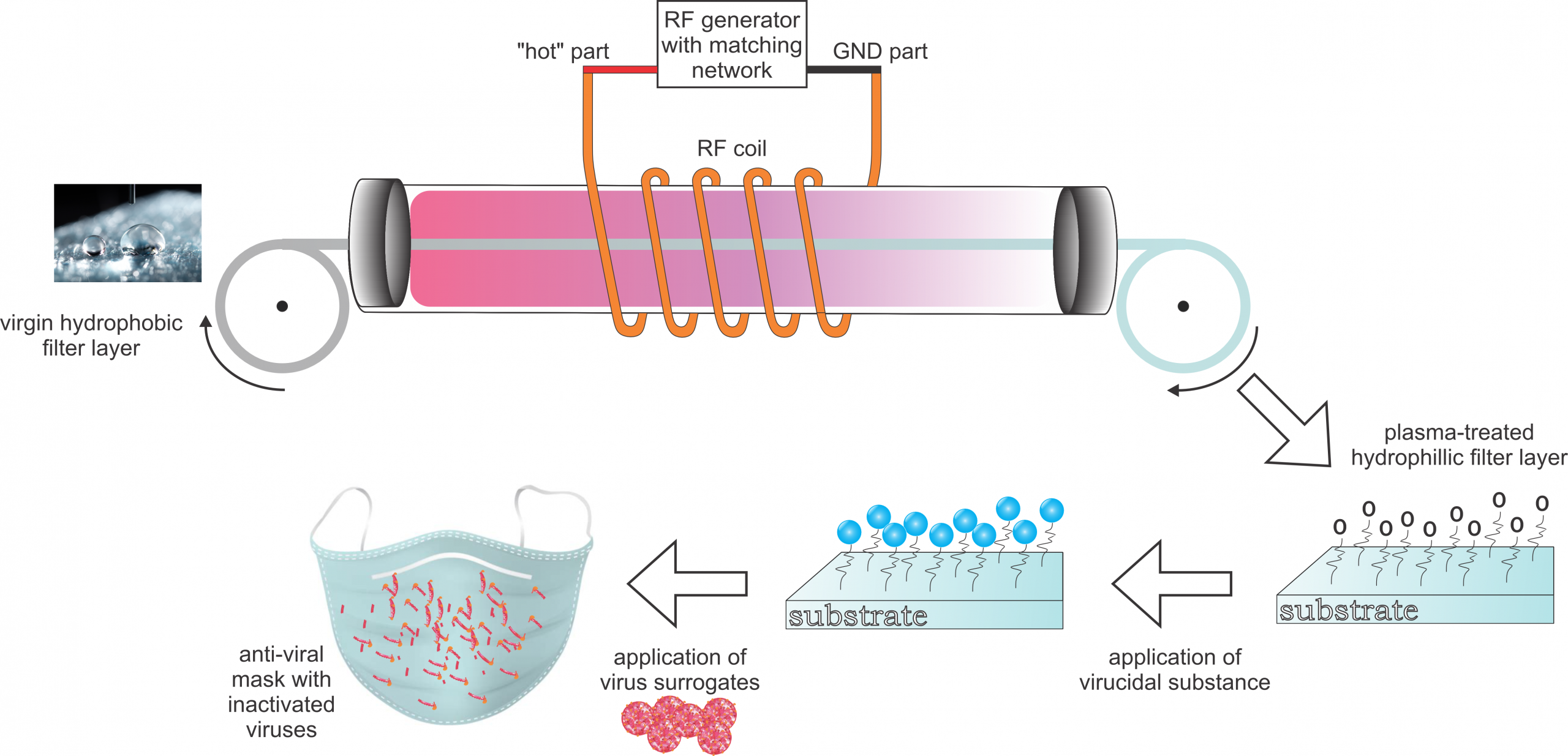
Slovenian health care was put to the test when the pandemic began in early spring 2020. Although government measures slowed down the spread of the virus, which bought time for reorganizing public health care, the pandemic still claimed too many victims. One of the first measures was the mandatory use of protective masks. Disposable medical masks reliably capture most viruses in exhaled or inhaled air but do not inactivate them.
Among the government’s measures was a tender for two-year projects, within which Slovenian research groups were supposed to investigate alternative options for curbing the virus’s spread. Our research group received funding to investigate the feasibility of such a treatment for nonwoven textiles in respiratory masks, enabling rapid virus inactivation in addition to capture. The project was successful, as we produced several mask prototypes and demonstrated their virucidal efficacy. Based on the results of prototype testing, we submitted a patent application. The project was thus accomplished, but it did not enable the widespread use of innovative masks, as additional research is needed for that. As part of the current project application, we intend to investigate the processing parameters in detail to optimize the process. We know that innovative processing is useful for making masks only when we demonstrate that the process is repeatable, reliable, and can be scaled to industrial applicability. In addition, the procedure must be affordable. Research on the inactivation of viruses on selected materials is time consuming, so in the framework of the project, we intend to investigate the influence of process parameters on the reliability of the capture and inactivation of Phi6, a surrogate for coronaviruses, and for selected samples inactivation of murine hepatitis virus (MHV, belongs to the same genus as SARS-CoV-2), on textiles, which are typically used as filter material in disposable respiratory masks ((melt-blown) polypropylene, polyethylene terephthalate, cotton, or lyocell fibers). We will determine the Phi6 inactivation rate as a function of process parameters and identify the parameter range suitable for our respiratory mask process. We will also investigate textile processing in continuous mode, i.e., continuous treatment. The process will also be interesting for treating textile products used in medical practice, such as gowns, (protective) clothes, bedding, drapes, etc. Four complementary research groups with expertise in the following scientific fields participate in the project: materials processing using advanced techniques to tailor the surface properties of porous materials, textiles, virology (microbiology), toxicology, and a certified laboratory.